Author

admin

Browsing

Here are some charts that reflect our areas of focus this week at


XLU Leads with New High

Even though the Utilities SPDR (XLU) cannot keep pace with the Technology SPDR (XLK) and Communication Services SPDR (XLC), it is in a leading uptrend. XLU formed a cup-with-handle from November to July and broke to new highs the last two weeks. ETFs hitting new highs are in strong uptrends and should be on our radar.


Metal Mania in 2025

In a tribute to Ozzy, metals are leading the way higher in 2025. The PerfChart below shows year-to-date performance for the continuous futures for 12 commodities. Copper, Platinum and Palladium are up more than 45% year-to-date, while Gold is up 28.38% and Silver is up 35.30%. QQQ is up 10.52% year-to-date, but lagging these metals. The other commodities are mixed.


Multi-Year Highs for Silver and Copper

The next chart shows 11 year bar charts for five metals. Gold broke out in early 2024 and led the metals move with an advance the last 21 months. Silver and copper broke out to multi-year highs. Platinum broke above its 2021 high and Palladium got in the action with an 18 month high. There is a clear message here: metals are moving higher and leading as a group.  


Home Construction Hits Moment of Truth

The Home Construction ETF (ITB) hit its moment of truth as it rose to its falling 40-week SMA. Notice that ITB failed just below this moving average in August 2023. During the 2023-2024 uptrend, the 40-week SMA was more friendly as ITB reversed near this level in October 2023 and June 2024. ITB surged to the falling 40-week SMA in July, but the long-term trend is down and this area could be its nemesis.

Thanks for Tuning in!

See TrendInvestorPro.com for more


The S&P 500 ($SPX) just logged its fifth straight trading box breakout, which means that, of the five trading ranges the index has experienced since the April lows, all have been resolved to the upside.

How much longer can this last? That’s been the biggest question since the massive April 9 rally. Instead of assuming the market is due to roll over, it’s been more productive to track price action and watch for potential changes along the way. So far, drawdowns have been minimal, and breakouts keep occurring. Nothing in the price action hints at a lasting change — yet.

While some are calling this rally “historic,” we have a recent precedent. Recall that from late 2023 through early 2024, the index had a strong start and gave way to a consistent, steady trend.

From late October 2023 through March 2024, the S&P 500 logged seven consecutive trading box breakouts. That streak finally paused with a pullback from late March to early April, which, as we now know, was only a temporary hiccup. Once the bid returned, the S&P 500 went right back to carving new boxes and climbing higher.

New 52-Week Highs Finally Picking Up

If there’s been one gripe about this rally, it’s that the number of new highs within the index has lagged. As we’ve discussed before, among all the internal breadth indicators available, new highs almost always lag — that’s normal. What we really want to see is whether the number of new highs begins to exceed prior peaks as the market continues to rise, which it has, as shown by the blue line in the chart below.

As of Wednesday’s close, 100 S&P 500 stocks were either at new 52-week highs or within 3% of them. That’s a strong base. We expect this number to continue rising as the market climbs, especially if positive earnings reactions persist across sectors.

Even when we get that first day with 100+ S&P 500 stocks making new 52-week highs, though, it might not be the best time to initiate new longs.

The above chart shows that much needs to align for that many stocks to peak in unison, which has historically led to at least a short-term consolidation, if not deeper pullbacks — as highlighted in yellow. Every time is different, of course, but this is something to keep an eye on in the coming weeks.

Trend Check: GoNoGo Still “Go”

The GoNoGo Trend remains in bullish mode, with the recent countertrend signals having yet to trigger a greater pullback.

Active Bullish Patterns

We still have two live bullish upside targets of 6,555 and 6,745, which could be with us for a while going forward. For the S&P 500 to get there, it will need to form new, smaller versions of the trading boxes.

Failed Bearish Patterns

In the chart below, you can view a rising wedge pattern on the recent price action, the third since April. The prior two wedges broke down briefly and did not lead to a major downturn. The largest pullbacks in each case occurred after the S&P 500 dipped below the lower trendline of the pattern.

The deepest drawdown so far is 3.5%, which is not exactly a game-changer. Without downside follow-through, a classic bearish pattern simply can’t be formed, let alone be broken down from.

We’ll continue to monitor these formations as they develop because, at some point, that will change.

Is the market’s next surge already underway? Find out with Tom Bowley’s breakdown of where the money is flowing now and how you can get in front of it.

In this video, Tom covers key moves in the major indexes, revealing strength in transports, small caps, and home construction. He identifies industry rotation signals, which are pointing to aluminum, recreational products, and furnishings. Tom then demonstrates how to use StockCharts’ tools to scan for momentum stocks in emerging leadership groups — see why SGI tops Tom’s list. He ends with a discussion of post-earnings reactions from major names like GOOGL, TSLA, IBM, and LVS. 

And, of course, Tom wraps every idea with clear chart setups you can act on today. 

This video premiered on July 24, 2025. Click this link to watch on Tom’s dedicated page.

Missed a session? Archived videos from Tom are available at this link.

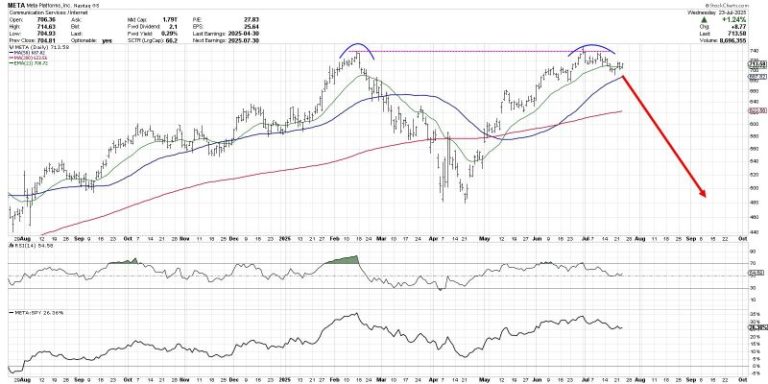
The chart of Meta Platforms, Inc. (META) has completed a roundtrip from the February high around $740 to the April low at $480 and all the way back again.  Over the last couple weeks, META has now pulled back from its retest of all-time highs, leaving investors to wonder what may come next.

Is this the beginning of a new downtrend phase for META?  Or just a brief pullback before a new uptrend phase propels META to new all-time highs?

Today we’ll look at two potential scenarios, including the double top pattern and the cup and handle pattern, and share which technical indicators and approaches could help us determine which path plays out into August.

The double top scenario basically means that the late July retest of the previous all-time high was the end of the recent uptrend phase.  The double top pattern is literally when a major resistance level is set and then retested.  The implication is that a lack of willing buyers means the uptrend is exhausted, and there is nowhere to go but down.

While the 21-day exponential moving average is currently in play for META, I would say that a break below the 50-day moving average could confirm this as the correct scenario.  If that smoothing mechanism does not hold, then the price action would imply less of a pullback and more like the beginning of a real distribution phase.

What is META pulls back but then resumes an uptrend phase, leading META to another new all-time high?  That would result in a confirmed cup and handle pattern, created by a large rounded bottoming pattern followed by a brief pullback.  The key to this pattern is the “rim” of the cup, which sits right at $740 for META.

Given the pullback META has demonstrated so far in July, I would say that a break above the $740 level would basically confirm a bullish cup and handle pattern.  That would suggest much more upside potential for META, as the stock would literally go into previously uncharted territory.

So how can we determine which scenario is more likely to play out?  This is where we need to incorporate more technical indicators into the discussion, as a way to further validate and confirm our investment thesis.

Just to review, I think a break above $740 would confirm a bullish cup and handle pattern.  I would also say that a break below the $680 level, which would represent a move below the 50-day moving average as well as the June swing lows, would basically confirm a bearish double top pattern.

We can also use the Relative Strength Index (RSI) to help determine whether META remains in a bullish trend phase.  During bull phases, the RSI rarely gets below 40, because buyers usually step in to “buy the dips” and keep the momentum fairly constructive.  So if the price would break down, and the RSI would not hold that crucial 40 level, that could mean a bearish outlook is warranted.

Finally, we can use volume-based indicators to assess whether moves in the price are supported by stronger volume readings.  Here I’ve included the Accumulation/Distribution Line, which tracks the trend in daily volume readings over time.  We can see that the high in July resulted in a divergence, as the A/D line was trending lower.  If the A/D line would break below its June and July lows, marked by a dashed red line, that would represent a bearish volume reading for META.

Technical analysis is less about predicting the future, and more about determining the most probable scenarios based on our analysis of trend, momentum, and volume.  I hope this discussion shows how the outlook for META can be easily determined and tracked using the best practices of technical analysis!

RR#6,

Dave

PS- Ready to upgrade your investment process?  Check out my free behavioral investing course!

David Keller, CMT

President and Chief Strategist

Sierra Alpha Research LLC

marketmisbehavior.com

https://www.youtube.com/c/MarketMisbehavior

Disclaimer: This blog is for educational purposes only and should not be construed as financial advice.  The ideas and strategies should never be used without first assessing your own personal and financial situation, or without consulting a financial professional.  

The author does not have a position in mentioned securities at the time of publication.    Any opinions expressed herein are solely those of the author and do not in any way represent the views or opinions of any other person or entity.

IAMGOLD (TSX:IMG,NYSE:IAG) is tightening its grip on one of Québec’s most promising gold districts with back-to-back acquisitions aimed at consolidating control over a vast stretch of the Chibougamau region.

In the span of two days, the mid-tier gold producer announced definitive agreements to acquire Northern Superior Resources (TSXV:SUP,OTCQB:NSUPF) and Mines d’Or Orbec (TSXV:BLUE).

Collectively the deals will expand its landholding to more than 100,000 hectares.

The larger of the two transactions will see IAMGOLD acquire all issued and outstanding shares of Northern Superior Resources in a cash-and-stock deal valued at approximately C$267.4 million.

The acquisition will fold Northern Superior’s Philibert, Chevrier and Croteau projects into IAMGOLD’s existing Nelligan and Monster Lake holdings, creating what the company has branded the Nelligan Mining Complex.

Together, these properties host estimated measured and indicated mineral resources of 3.75 million ounces of gold and inferred resources of 8.65 million ounces, positioning the district as Canada’s fourth largest pre-production gold camp.

“The addition of Northern Superior’s assets to IAMGOLD’s Nelligan Mining Complex in the Chibougamau region of Québec is extremely exciting for IAMGOLD, the region and our mutual shareholders,” said Renaud Adams, IAMGOLD’s president and CEO. “This acquisition aligns with our strategy to become a leading Canadian-focused mid-tier gold producer, bolstering our organic pipeline in Québec where we have maintained a longstanding presence.”

A day earlier, IAMGOLD struck a deal to acquire Mines d’Or Orbec, a junior explorer advancing the Muus project southwest of Chibougamau. IAMGOLD already holds a 6.7 percent equity interest in Orbec and expects to issue roughly 369,000 new shares to complete the purchase. The transaction will bring Muus under IAMGOLD’s control.

Located at the intersection of the Fancamp and Guercheville deformation zones, which are two major mineralized corridors that also host IAMGOLD’s Monster Lake and Nelligan deposits, the 24,979 hectare Muus project has been viewed as a geological link between the company’s existing holdings.

“Over the past several years, we have advanced the Muus project into one of Québec’s most promising gold exploration plays,” Orbec CEO John Tait said.

With the addition of both Northern Superior and Orbec, IAMGOLD is set to more than double its regional footprint.

The company has signaled its intent to pursue a “hub-and-spoke” development strategy in the region, envisioning a central processing facility fed by multiple ore sources within a 17 kilometre radius.

Pending regulatory and shareholder approvals, both acquisitions are expected to close in late 2025 or early 2026.

The price of gold has surged to unprecedented levels this month, reaching an all-time high of around US$4,370 per ounce amid heightened safe-haven demand and expectations of US interest-rate cuts.

However, on Tuesday (October 21), a correction began to set in as the yellow metal pulled back sharply. It fell as much as 5.5 percent to about US$4,115 as profit taking kicked in and the US dollar strengthened.

Securities Disclosure: I, Giann Liguid, hold no direct investment interest in any company mentioned in this article.

This post appeared first on investingnews.com

Chris Vermeulen, chief market strategist at TheTechnicalTraders.com, weighs in on gold’s record-setting price run and what could be next for the metal.

Vermeulen also discusses the outlook for silver, platinum and palladium.

Securities Disclosure: I, Charlotte McLeod, hold no direct investment interest in any company mentioned in this article.

This post appeared first on investingnews.com

Astron (ASX:ATR) said on Monday (October 20) that Australia has granted major project status to the Donald rare earths and mineral sands project, its joint venture with Energy Fuels (TSX:EFR,NYSEAMERICAN:UUUU).

Donald is located approximately 300 kilometers northwest of Melbourne in Minyip, Victoria, Australia, and is regarded as “one of the world’s most significant rare earths resources outside China.”

It currently holds a total mineral resource of 1.81 billion tonnes grading 4.6 percent.

“This (designation) will streamline our engagement with federal agencies and accelerate our pathway to development,” commented Astron Managing Director Tiger Brown in a press release. “The Donald project will create significant employment opportunities and deliver long-term economic benefits to the Wimmera region of Victoria as well as strengthen Australia’s sovereign capability in critical minerals and advanced technology supply chains.”

Donald has a planned mine life of 58 years, with expected annual output of 9,000 tonnes of rare earths in Phase 1.

In a separate announcement, Energy Fuels said Export Finance Australia (EFA) has expressed support for the project and will provide AU$80 million via senior debt financing. The total amount needed to develop Donald is AU$520 million.

Energy Fuels CEO Mark Chalmers said that the support is a “key additional step” in the project’s financing pathway and a “strong vote of confidence” in the project’s capacity and potential.

“(It) reflects our on-going progress toward delivering one of Australia’s most important rare earth projects, including valuable NdPr, and exceptional concentrations of Dy, Tb and other ‘heavy’ rare earth oxides, which upon project development will be processed and separated into high-purity products at our White Mesa Mill in Utah,” he added.

According to a work plan for Donald published in June, the progression towards a final investment decision for the project is expected within 2025. Commencement of production at Donald is scheduled for 2027.

Rare earths have been heavily spotlighted this month after China dramatically expanded its control over rare earth exports, a sector crucial to global tech and defense industries.

The October 10 announcement from the Ministry of Commerce adds five new elements — holmium, erbium, thulium, europium and ytterbium — along with key refining technologies to its export control list.

The new rules carry a global reach: any foreign company producing rare earth materials or magnets using Chinese-origin equipment or technology must now obtain an export license from Beijing.

Crucially, applications for defense-related or advanced semiconductor projects, including cutting-edge AI with military potential, will face intense scrutiny and are likely to be denied.

Securities Disclosure: I, Gabrielle de la Cruz, hold no direct investment interest in any company mentioned in this article.

This post appeared first on investingnews.com

Spartan Metals (TSXV:W) is a US-focused explorer advancing its high-grade tungsten and rubidium Eagle Project in Nevada. The company is unlocking critical minerals essential to US defense, technology, and energy independence, supporting onshoring goals under the Defense Production Act.

The Eagle tungsten-silver-rubidium project in eastern Nevada spans 4,936 acres across three historic mine areas — Tungstonia, Rees, and Antelope. With historic production of 8,379 units of WO₃ grading 0.6–0.9 percent, Eagle ranks among the highest-grade past-producing tungsten systems in the US, enriched with rubidium and other defense-critical metals including antimony, bismuth, indium, and arsenic. Spartan is advancing an exploration program to validate and expand this potential using modern geochemistry, geophysics, and tailings drilling.

With multiple mineralized zones, district-scale potential and strong alignment with US strategic metal initiatives, the Eagle project is the cornerstone of Spartan’s growth strategy.

Company Highlights

  • Flagship Eagle Project: One of the highest-grade, past-producing tungsten mines in the US.
  • Multi-metal Exposure: Targets tungsten, rubidium, antimony, bismuth, and silver – all listed as US critical minerals.
  • Tier-1 Mining Jurisdiction: Located in eastern Nevada, a world-class mining state with established infrastructure and regulatory clarity.
  • Strong Management and Technical Team: Led by a CEO and VP of exploration with proven discovery track
  • Alignment with US Critical Minerals Strategy: Positioned to benefit from Department of Defense and US government initiatives supporting domestic critical mineral supply chains.
  • Attractive Capital Structure: Tight share strucuture with management and board holding ~42 percent of shares outstanding, ensuring strong alignment with investors.

This Spartan Metals profile is part of a paid investor education campaign.*

Click here to connect with Spartan Metals (TSXV:W) to receive an Investor Presentation

This post appeared first on investingnews.com

Investor Insight

Spartan Metals offers a compelling investment opportunity in the US critical minerals sector through its high-grade, 100-percent-owned Eagle tungsten-silver-rubidium project in Nevada. With strong grades, multi-metal exposure, and alignment with US defense and supply chain initiatives, Spartan provides investors with exceptional leverage to the growing demand for domestically sourced strategic critical minerals.

Overview

Spartan Metals (TSXV:W) is a US-focused critical minerals explorer advancing its high-grade tungsten and rubidium asset in Nevada. Through its flagship Eagle project, the company is unlocking American critical mineral resources essential to defense, technology and energy independence. Spartan’s projects are strategically positioned to contribute directly to the United States’ onshoring objectives under the Defense Production Act and related supply-chain initiatives.

Eagle project site in Nevada

The Eagle tungsten-silver-rubidium project in eastern Nevada anchors a district-scale opportunity covering 4,936 acres across three historic mine areas – Tungstonia, Rees and Antelope. With historic production of 8,379 units of tungsten trioxide (WO₃) at grades between 0.6 to 0.9 percent, the project hosts one of the highest-grade past-producing tungsten systems in the United States, enriched by rubidium and other US defense-critical metals such as antimony, bismuth, indium and arsenic. Spartan is now executing an exploration program to validate and expand this potential through modern geochemistry, geophysics and tailings drilling.

Led by a team with deep Nevada exploration experience and direct US Department of Defense (DOD) engagement, Spartan is pursuing a partnership-driven approach to project advancement. It combines early-stage exploration and reprocessing opportunities and joint ventures to accelerate development. With a strong insider ownership base (42 percent) and exposure to multiple critical metals, Spartan Metals is an emerging US leader in strategic mineral discovery and domestic supply security.

Company Highlights

  • Flagship Eagle Project: One of the highest-grade, past-producing tungsten mines in the US.
  • Multi-metal Exposure: Targets tungsten, rubidium, antimony, bismuth, and silver – all listed as US critical minerals.
  • Tier-1 Mining Jurisdiction: Located in eastern Nevada, a world-class mining state with established infrastructure and regulatory clarity.
  • Strong Management and Technical Team: Led by a CEO and VP of exploration with proven discovery track
  • Alignment with US Critical Minerals Strategy: Positioned to benefit from Department of Defense and US government initiatives supporting domestic critical mineral supply chains.
  • Attractive Capital Structure: Tight share strucuture with management and board holding ~42 percent of shares outstanding, ensuring strong alignment with investors.

Key Asset: Eagle Project

Spartan’s 100-percent-owned Eagle project in White Pine County, Nevada, is a nationally significant critical mineral asset which includes the past-producing Tungstonia, Rees and Antelope mines. The Eagle project historically produced over 8,000 units of WO₃ between 1915 and 1956, and now presents a rare opportunity to redefine one of the highest-grade tungsten and rubidium systems in the United States.

With multiple mineralized zones, district-scale potential and strong alignment with US strategic metal initiatives, the Eagle project is the cornerstone of Spartan’s growth strategy.

Project Highlights

  • District-scale Footprint with High-grade Legacy Production: 4,936 acres (20 sq km) across 244 BLM claims in eastern Nevada; Past-producing Tungstonia and Rees mines averaged 0.6 to 0.9 percent WO₃, with channel samples up to 5.32 percent WO₃
  • Rubidium Discovery: Rock chip assays up to 2,264 parts per million (ppm) rubidium, positioning Eagle as a potentially significant US rubidium source
  • Polymetallic Opportunity: System hosting tungsten-rubidium-silver with antimony, bismuth and arsenic, all metals critical for US defense sector
  • Three Deposit Types: Features porphyry, skarn and carbonate replacement deposit (CRD) styles, a rare combination that indicates a large, long-lived hydrothermal system capable of hosting multiple mineralization centers, supporting district-scale exploration potential
  • Active 2025 Exploration Program: Fieldwork commenced in October 2025, executing Phase 1 of its NI 43-101-recommended program and part of Phase 2. Activities include drilling of historic Tungstonia tailings, detailed soil and rock sampling, geologic mapping and CSAMT/MT geophysics to define high-priority tungsten-rubidium drill targets and support future resource modeling.
  • Tailings Reprocessing Opportunity: ~9,000 tonnes of tailings averaging 0.14 percent WO₃ and 460 ppm rubidium offer near-term reclamation value-add
  • Tier-1 Mining Jurisdiction: Excellent access to infrastructure near Ely, Nevada
  • Strategic Positioning: Fully aligned with US DOD and Department of Energy initiatives to secure domestic tungsten and rubidium supply chains

Management Team

Brett R. Marsh – President, CEO and Director

Brett Marsh is a professional geologist with more than 25 years of experience in mineral exploration and project development across North America and internationally. Marsh previously led major exploration initiatives for both junior and mid-tier mining companies and has extensive experience in tungsten and critical mineral systems. He oversees Spartan’s technical and strategic direction and is the company’s “qualified person under NI 43-101..

Rebecca Ball – Vice-president, Exploration

Rebecca Ball brings over a decade of exploration and operational experience across base, precious and critical minerals. She specializes in greenfield targeting and geological modeling, most recently leading the McDermitt Lithium stratigraphy initiative that expanded its resource significantly. Her expertise is instrumental in defining the next phase of resource development at the Eagle project.

Michael Harp – Director

Currently VP Exploration at Ridgeline Minerals, Michael Harp has over 15 years of exploration experience in Nevada, including the discovery of over 5 million ounces of gold in the Carlin Trend’s Railroad-Pinion district. His extensive field and project management experience supports Spartan’s Nevada-focused exploration programs.

Terese Gieselman – Chief Financial Officer and Corporate Secretary

Terese Gieselman is a seasoned financial executive with over 30 years of experience in public company management and corporate finance in the mining sector. She brings expertise in governance, financial reporting, and capital markets strategy that will support Spartan’s growth.

This post appeared first on investingnews.com

BNB Price Surge Leads Crypto Gains as Bitcoin Climbs

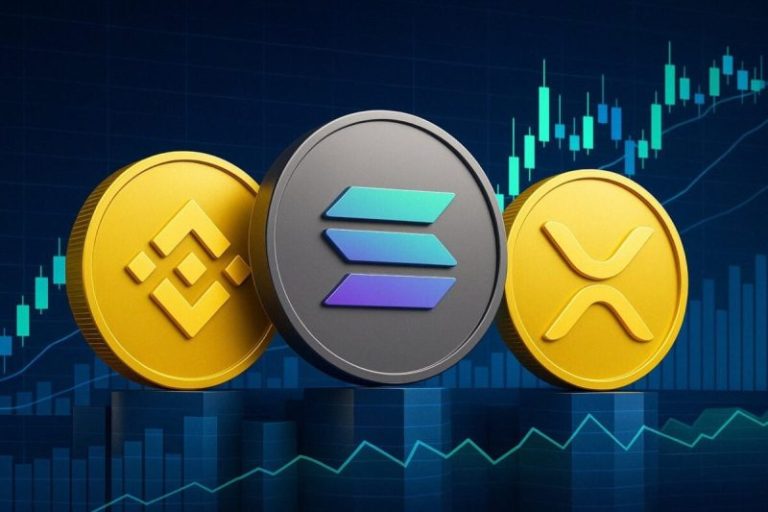
The BNB price surge on April 21, 2025, stole the spotlight as Binance Coin jumped over 3.2% to cross the $600 mark. This move came as Bitcoin soared past $87,000, reigniting investor interest in altcoins. The bullish wave didn’t stop with BNB—SOL and XRP also made strong moves, reflecting a positive trend across the cryptocurrency market.

BNB Price Surge Driven by Token Burn and Momentum

Fueling the BNB price surge was Binance’s recent $1 billion token burn, which reduced the circulating supply. Additionally, increased trading volumes and renewed faith in Binance’s ecosystem helped BNB regain upward momentum. Investors are optimistic that Binance’s expansion and focus on compliance could drive long-term growth.

SOL Rally and XRP Breakout Add to Market Optimism

Solana (SOL) saw a 10.2% rally, breaking above the $135 resistance level with strong volume and technical confirmation. XRP, on the other hand, climbed past $2.10, setting the stage for a potential breakout above $2.15. These moves indicate bullish setups that are gaining attention from both traders and long-term holders.

Bitcoin Reinforces Its Role as Digital Gold

Bitcoin’s rise above $87,000 reflects renewed demand for a digital safe-haven. With increasing global economic uncertainty and inflation concerns, many investors view Bitcoin as “digital gold.” This sentiment is spilling over into altcoins, triggering the current crypto rally.

Conclusion and Market Outlook

The BNB price surge highlights growing investor confidence in altcoins. Alongside Bitcoin’s strength, tokens like SOL and XRP are enjoying increased attention. If this trend continues, more gains could be ahead for altcoin markets. Investors should monitor resistance levels and trading volumes closely for signs of sustained momentum.

Source: Yahoo Finance

Related: Crypto Updates | Market Trends

The post BNB Price Surge Leads Crypto Gains as Bitcoin Climbs appeared first on FinanceBrokerage.