Author

admin

Browsing

For years, California Gov. Gavin Newsom has reaped the benefits of Silicon Valley’s AI boom — in the form of tax revenue for his state and political contributions from industry leaders.

Newsom’s interests often aligned with those of tech titans, and he largely protected those interests. In 2024, for example, he vetoed a bill that would have created legal liabilities for artificial intelligence companies in the event of catastrophes involving terrorism, mass casualties or other damage to society. It would also have required the companies to maintain kill switches so that AI processes could be turned off.

Newsom has long talked about the need to find a practical balance between utopian corporate visions of AI’s upsides and dystopian populist nightmares of human subservience to machines.

“Given the stakes — protecting against actual threats without unnecessarily thwarting the promise of this technology to advance the public good — we must get this right,” he said in his veto message.

But as he lays the groundwork for a widely anticipated 2028 presidential bid, Newsom is shifting his weight away from the corporate end of the balance and toward the populist end. The move could have implications not only for the Democratic nomination fight, but also in a general election, as the political left and right have coalesced around concerns about AI driving up costs to consumers and posing threats to liberty, cybersecurity and physical safety.

The issue has bedeviled elected officials in both parties at the federal and state levels.

They are clearly feeling heat from the public over a wide variety of AI-related issues, from potential job losses, the expensive energy demands of data centers and sexual exploitation, to more abstract fears of Americans’ lives being run by a handful of the rich and powerful through the use of advanced machines.

On the other side, tech giants bring in money — and spend lavishly on campaigns — and national security experts warn that unilateral disarmament in the AI arms race is a recipe for disaster.

Last week, President Donald Trump scuttled his own planned executive order on AI regulation at the last minute, citing concerns that it might “get in the way” of the country’s ability to compete with China.

At the same time, Newsom is using his power as California’s chief executive to begin rolling out initiatives to beef up AI controls.

Jason Elliott, a policy-minded political consultant who served as Newsom’s deputy chief of staff, said the governor has had his hands deep in AI policy, whether it’s the frontier-safety law he backed last year — which requires major AI developers to identify and mitigate risks before deploying their products — or the legislation he vetoed the year before.

“Just because you can name a problem and take a problem very seriously doesn’t mean that every single solution someone proposes is proper,” Elliott said. “I have never seen an issue move as quickly as AI, and it’s not even close. So every elected official’s position naturally should be evolving on AI from week to week and month to month, because the underlying technology itself seems to change every day.”

Newsom is evolving in real time, to the delight of some progressives who believed he was dragging his feet on behalf of corporations and donors.

Last week, Newsom signed an executive order requiring state agencies to work with industry groups, academics and organized labor to develop plans for assessing and offsetting AI’s effects on California workers.

“The whole system has to be reimagined, and we’re not — I don’t think we’re having an accelerated or advanced conversation right now; we’re still discussing who’s going to pay for my increased electricity because of the data center, which is a legit issue,” Newsom said at a May 19 conference convened by the liberal think tank Center for American Progress in Washington. “But it’s not the issue, and … the tech genie is not going to go back in the bottle.”

Newsom also submitted a revised state budget proposal this month that would vastly increase antitrust enforcement dollars, which have been used to go after companies that use algorithms to set prices.

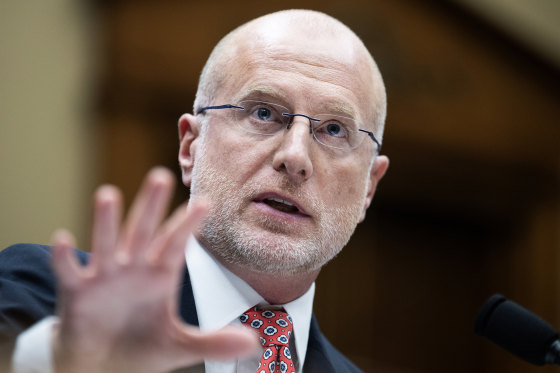
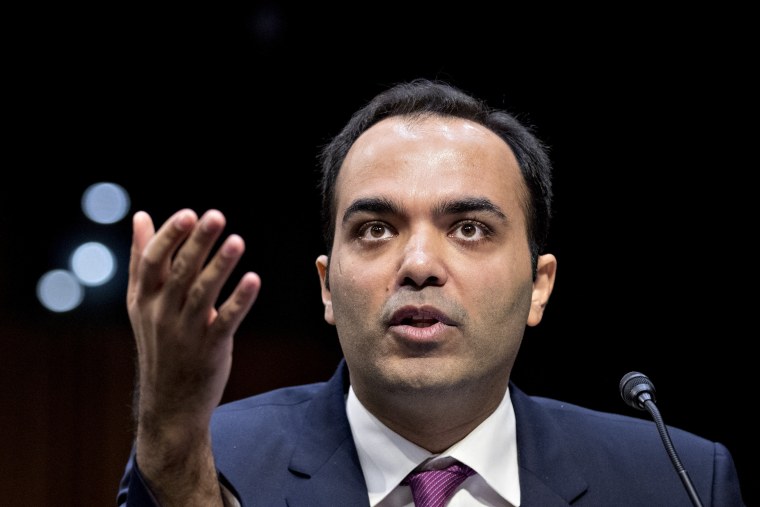
Former Consumer Financial Protection Bureau chief Rohit Chopra.Andrew Harrer / Bloomberg via Getty Images file

Earlier this month, he hired former Consumer Financial Protection Bureau chief Rohit Chopra, who has warned about potential excesses of AI, to head up a state business and consumer services agency. And, along with other prospective 2028 candidates, according to Axios, Newsom has been cozying up to Sen. Elizabeth Warren, D-Mass., who is among the loudest critics of AI’s economic implications.

Among the large crop of prospective 2028 hopefuls, there is a broad spectrum of views on AI and its various uses — and some uncertainty about when and how to regulate them. Data centers, which represent just a slice of AI policy, have become a flashpoint for voters and an area of attention for policymakers with White House ambitions.

Pennsylvania Gov. Josh Shapiro, for example, is tying accelerated permits for data centers to companies’ willingness to pay for power, provide workforce protections and conserve the environment. Rep. Alexandria Ocasio-Cortez, D-N.Y., has called for a moratorium on data centers and pressed federal officials on their impact on drinking water.

Like Newsom, Illinois Gov. JB Pritzker, who is also widely considered to be looking at a 2028 bid, is moving to demonstrate a more cautious approach to AI. In February, he proposed a two-year pause on tax incentives for building data centers.

A YouGov/Economist poll this month found that 71% of Americans — 77% of Democrats and 68% of Republicans — say AI development is “moving too fast.”

“It should be clear to anyone paying attention to polling or even just vibes that there is a lot of voter-level concern about AI and costs and who the economy is serving and who the economy isn’t serving,” Dan Geldon, a former top aide to Warren, said. “It makes sense that Newsom and other candidates would open channels with populists and consider their ideas in this environment.”

But revenue from “hyperscalers” — tech companies that build data centers to handle massive amounts of information — is attractive to many state executives in both parties.

“We’re looking at literally hundreds of millions of dollars annually to local government, cities, counties and school districts that the hyperscaler is going to pay in their fee and loop payments,” Mississippi Gov. Tate Reeves, a Republican who has welcomed data center investments from Amazon, xAI and other major players into his state, said in a recent interview.

And yet there are Republican governors who have taken a much more skeptical view of AI and of data centers.

Florida Gov. Ron DeSantis, a Republican, has pushed unsuccessfully to enact an AI “bill of rights” that would protect data privacy and prevent insurance companies from judging claims based on machine-dictated decisions. Like Reeves, he signed a law requiring hyperscalers to pay utility costs associated with their work.

For 2028 hopefuls in both parties, the opportunities and risks of developing AI policies at machine-learning speed are becoming more clear. For Newsom, there’s been a perceptible shift toward the populist leanings of the progressive wing of his party.

Elliott, his former aide, said it makes sense on a public policy level for the governor to keep up with changes in technology and adjust his response accordingly.

“It’s true that Gov. Newsom has continued to observe the state of the industry, the state of technology, and then update his perspectives as the industry moved forward,” Elliott said. “Republicans are doing the same thing and should be doing the same thing and there are a number of Republicans around the country who are taking the very hands-on approach to regulating artificial intelligence.”


Roughly 36,000 Heartwarming Hugs Bears, a stuffed animal manufactured by Build-A-Bear, are being recalled due to a zipper detaching from the bear’s pouch.

On Thursday, the U.S. Consumer Product Safety Commission announced that the stuffed animals pose a serious risk of injury or death, as the detached zipper can present a choking hazard.

The recall number is 034464. The recall number can be found on the product label located on the back of one of the bear’s legs.

The bear includes a stuffed heart that fits inside a pocket. The heart-shaped insert is filled with 2.5 pounds of ceramic beads and can be used as a heating pad or chilled for cooling comfort.

“The product is graded 3 years+ and carries a cautionary statement advising adult supervision due to the heated/cooled element,” the release stated.

The bear was sold between January 2026 and March 2026 for about $48.

Customers are advised to immediately stop using the Heartwarming Hugs Bear. Consumers who purchased the bear should return it to the nearest Build-A-Bear store or request a shipping label at www.buildabear.com/recalls. Once returned, Build-A-Bear will issue a refund to the original form of payment or provide a gift card.

There have been no reported injuries, although one consumer in the United Kingdom reported the zipper detaching.

For information on the recall visit Build-A-Bear online at www.buildabear.com/recalls according to the release.

Thermos is recalling 8.2 million containers after consumers suffered laceration injuries — and in some cases reported permanent vision loss — when stoppers forcefully ejected from the products and struck them in the face.

The recall covers approximately 5.8 million Stainless King Food Jars and 2.3 million Sportsman Food & Beverage Bottles. According to a recall notice posted by the U.S. Consumer Product Safety Commission on April 30, consumers should stop using the affected products immediately.

The affected models include Thermos Sportsman Food & Beverage Bottles: all units, model SK3010; Food Jars and Food & Beverage Bottles: all units, models SK3000 (16-ounce), SK3020 (24-ounce), and SK3010 (40-ounce); and Thermos Stainless King Food Jars manufactured before July 2023: models SK3000 and SK3020.

The model number can be found at the bottom of the item.

The hazard stems from a design flaw in the stopper — the component that retains heat and prevents leakage. If perishable food or beverages are stored for an extended period, pressure can build up and cause the stopper to forcefully eject when the container is opened. Unlike safer designs, the stopper on the recalled models lacks a pressure-relief valve.

Thermos said it has received 27 reports of consumers being struck by an ejected stopper, including injuries requiring medical attention. Three consumers reported suffering permanent vision loss after being struck in the eye.

The recalled products were sold between March 2008 and July 2024 at Walmart, Target, and Amazon, as well as on Thermos.com. They were available in a variety of colors and bear the Thermos trademark on the side.

Owners of SK3000 and SK3020 Food Jars should dispose of the stopper and submit a photo of the disposal to Thermos. Owners of SK3010 bottles should return the product using a prepaid shipping label provided by the company. For details on returns and replacements, visit the Thermos recall page at Thermos.com.

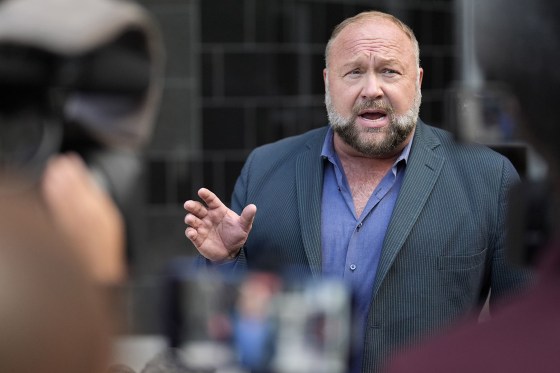
AUSTIN, Texas — The Onion’s plan to take over the Infowars platforms that Alex Jones built into a bullhorn of conspiracy theories and turn them into parody sites was in limbo again Thursday, after a Texas court paused a proposed deal involving the satirical news outlet.

Austin-based Infowars is facing liquidation because of the more than $1 billion in defamation lawsuit judgments Jones owes relatives of victims of the 2012 Sandy Hook Elementary School shooting for calling the Connecticut massacre a hoax. The proposed licensing deal would give The Onion temporary authority to use Infowars’ trademarks, copyrights and intellectual property while a state receiver in Texas works toward liquidation.

A state judge in Austin had scheduled a hearing Thursday on whether to approve The Onion deal with the receiver. But the proceeding fizzled into a status conference because the Texas Third Court of Appeals late Wednesday approved an emergency motion by Jones’ lawyers that temporarily blocked the transfer of any Infowars assets. The judge set another hearing for May 28.

Lawyers for the Sandy Hook families had asked the Texas Supreme Court to overturn the appeals court ruling, but the high court did not issue a decision before Thursday’s hearing.

“This newly insane, unprecedented legal stalling does nothing but delay our deal with the receiver to take control of InfoWars,” Ben Collins, The Onion’s CEO, said in a social media post ahead of the hearing. “We now expect new traps in Alex Jones’ amoral war to deny paying the Sandy Hook families, but we’re freshly surprised by the U.S. legal system’s appetite to put up with it.”

The Onion already has been selling Infowars merchandise on its own website, including T-shirts and tote bags with an Infowars logo that replaces the “o” with its trademark onion image. It wants to turn the Infowars platforms into comedy sites that would include spoofing Jones, conspiracy theories and right-wing talking points, while giving revenue to the Sandy Hook victims’ relatives.

Jones declared victory in videos posted on his social media sites after the appellate court ruling. He called The Onion’s plan illegal, citing pending appeals and his continuing personal bankruptcy case.

“I said days ago there’s no way the Third Circuit Court of Appeals in Texas doesn’t overturn this — you know they’re all Democrats — because it’s so outrageous what you’ve done,” Jones said.

After Thursday’s hearing, Mark Bankston, a lawyer for some of the Sandy Hook victims’ relatives, accused Jones of delaying the liquidation of Infowars numerous times with court filings.

“As far as the world is concerned, Infowars is dead. Everybody knows that,” he said. “He’s trying to keep the bloated corpse of a media organization alive. It’s all a joke. Everybody knows where this is going.”

It’s not the first time The Onion has hit a legal setback in plans to take over Infowars.

In November 2024, the Chicago-based satirical outlet was named the winner of a bankruptcy court auction of the assets of Infowars’ parent company, Free Speech Systems, aimed at helping pay some of the defamation judgments. But a federal judge overturned the auction results, citing problems with process and The Onion’s bid.

Jones said on his show this week that he has a new studio nearing completion. He already has set up a new phone app and websites, including one that sells the dietary supplements, clothing and other merchandise he hawks on his shows. And his personal X account, where he posts videos of his shows and has 4.5 million followers, is not affected by any of the court cases.

On Thursday night, Jones toasted to his crew and viewers during a livestream on X as a clock ticked down to when he said his final moments in the building would hit.

“We’re not here anymore because they’re turning the power off at midnight,” he said.

Market watchers looking for clarity about the direction of Big Tech and the AI investment boom didn’t get much Wednesday afternoon amid a barrage of key earning reports.

Instead, four leading tech companies reported quarterly results that beat Wall Street’s official forecasts but nevertheless fell short of the sky-high expectations investors have set for companies leading the AI revolution.

Investors were most enthusiastic about the results of Google parent Alphabet, whose shares climbed as much as 6% in after-hours trading. The company reported earnings and revenue that beat analysts’ expectations and raised its estimate of how much it would spend on AI infrastructure.

Earnings for Facebook parent Meta were greeted with less fervor. Its shares fell more than 5% after it said it expected revenue growth to stay flat in the second quarter.

Amazon’s and Microsoft’s results and forecasts were more mixed. Investors ultimately sent both lower by about 3%.

The major U.S. stock indexes are sitting near all-time highs despite war with Iran, rising oil prices and dismal consumer sentiment readings.

But overall business investment and consumer spending levels remain resilient — and companies on the S&P 500, the index considered the best proxy for overall stock market performance, are reporting the highest average net profit margins in more than 15 years, according to the analytics group FactSet.

That performance is being led by tech companies known as “The Magnificent 7” — Apple, Microsoft, Alphabet, Amazon, Meta, Nvidia and Tesla, which dictate about one-third of the S&P 500’s average performance.

Tech’s leadership has created a double-edged sword for the market writ large: When times are good in tech, the market tends to rise. When tech’s performance is rockier, the market can sink.

“Stocks are again trading at record highs, reflecting strong investor confidence, but the S&P 500’s heavy concentration in the Mag 7 technology leaders elevates downside risk should earnings fall short, as valuations leave little margin for error,” Chris Brigati, chief investment officer at SWBC, a Texas-based financial group with more than $1 billion in assets under management, said in a note to clients this week.

Investors remain focused on the companies’ projections for future spending levels on the technology and infrastructure underlying their AI programs — and how they square with revenue, Brigati said.

“Each company faces its own dynamics, but delivering tangible results from elevated [capital expenditures] remains the critical test,” he said.

Until the end of March, Mag 7 companies’ performance had been caught in the downdraft that hit the broader market as the war with Iran took hold. Many had already spent much of the second half of 2025 treading water as concerns about the timeline for earnings from AI investments, plus seemingly circular financing arrangements, took hold.

But sometime in early April, investors began to realize that the most important names had been trading at discounts relative to projected earnings, according to Ed Yardeni, an economist and president of Yardeni Research, a widely respected market consultancy.

“I think the perception that there might be an exit ramp for Trump with the war with Iran and ceasefire got investors looking at markets again, and what they suddenly realized is the overall market, and specifically the Mag 7, were a lot cheaper,” Yardeni told NBC News.

In recent days, the market has lost some momentum amid signals that President Donald Trump is planning for a more prolonged conflict. A Wall Street Journal report that ChatGPT maker OpenAI may be on track to miss key revenue and user targets has also slowed tech’s recent momentum. OpenAI investments in — and from — other major tech companies have left it deeply intertwined in the AI boom, and some investors fear any weakness could ripple through parts of the AI ecosystem.

OpenAI called the Journal report “clickbait.”

The actual severity of any shortcomings at OpenAI and how far any weaknesses could spread remain open questions, Yardeni said. For now, cautious investor optimism remains the prevailing sentiment and will most likely continue to power markets higher.

“Concerns about some of the uncertainties, like if these companies are spending too much or if they’ll ever get a proper rate of return, that seems to have gone by the wayside,” he said.

President Donald Trump will be briefed Thursday on options for the way ahead in the Strait of Hormuz and on the ground in Iran, according to a U.S. official familiar with the planning.

Adm. Brad Cooper, the commander of U.S. Central Command, will brief Trump and his senior national security team at the White House, the official said, and update them on the continued U.S. blockade of Iran’s ports.

The update came after energy prices soared to their highest point in years with little sign of a deal to end the war.

Iran’s new supreme leader vowed in a message earlier Thursday that the Islamic Republic would protect its “nuclear and missile capabilities” as national assets.

The defiant written statement, read on state television, was the latest signal that Tehran was not about to capitulate in the standoff wreaking havoc on the global economy.

The price of the international benchmark for oil, Brent crude, rose to more than $126 a barrel at one point overnight — the highest since 2022, when Russia launched its invasion of Ukraine — before falling back to around $114 a barrel early Thursday.

Gas prices in the United States rose to an average of $4.30 a gallon Thursday, also the highest level in nearly four years.

The spike came following an Axios report that the U.S. military was set to brief President Donald Trump on plans for potential military action to help break the deadlock in talks to end the war and reopen the key trade route.

One plan prepared by U.S. Central Command includes a wave of “short and powerful” strikes intended to force Iran back to the negotiating table, Axios reported.

A senior Revolutionary Guard commander vowed swift retaliation if the U.S. does renew its assault.

“With prolonged and wide-ranging painful strikes, we will, by the grace of God, respond to the enemy’s operations even if they are rapid and short,” Seyed Majid Mousavi said on social media Thursday.

“We have seen the fate of your fragile bases in the region; we will also see your warships,” he said.

It comes after Trump warned that Iran had “better get smart soon” as he weighed possible military options to reopen the strait, through which some 20% of the world’s oil passes.

Traffic in the waterway has been at an effective standstill since Iran attacked shipping after the U.S. and Israel launched their joint military assault in late February, rattling the global economy.

Washington launched its own blockade of Iranian ports in response, and Trump told Axios on Wednesday that it would stay in place until Iran agreed to a nuclear deal.

That seemingly rules out a new Iranian proposal to end the war and reopen the strait without resolving the impasse over the Islamic Republic’s nuclear program. Trump said he saw the blockade as “somewhat more effective than the bombing.”

Trump told reporters at the White House on Thursday that the blockade is working well.

“The power of the blockade is incredible. They’re not getting any money from oil, and hopefully it can be worked out very soon,” he said.

Trump added, “Iran is dying to make a deal.”

Trump and other top administration officials met with a group of energy industry executives earlier this week to discuss key issues, including Washington’s possible next steps in continuing the blockade “for months if needed,” a White House official told NBC News.

Members of Trump’s national security team presented him with multiple options this week for how to handle the bottleneck, a U.S. official and a person familiar with the meeting told NBC News. The options discussed included whether the U.S. military presence in the strait should change — either increase or decrease — and whether the military should become more aggressive in conducting operations there, the U.S. official said.

The prospect of prolonged disruption in the strait has sent energy prices soaring despite the ceasefire. “Our world is facing a major economic and energy challenge,” International Energy Agency head Fatih Birol told a conference in Paris.

Federal Communications Commission Chairman Brendan Carr told reporters Thursday that the White House did not push him to order an early review of ABC’s eight broadcast licenses.

“There was no pressure from the outside. There was no suggestion from the outside,” Carr said at a news conference. “There was no call for agency action from the outside. This was based on our assessment of where we were.”

The FCC, which regulates the broadcast industry, announced its early review on Tuesday, a day after President Donald Trump publicly called on ABC to fire late-night host Jimmy Kimmel for a joke he made about first lady Melania Trump last week.

Carr, a Trump appointee who regularly assails the media, reiterated Thursday that the review of ABC’s licenses stemmed from a yearlong investigation into diversity, equity and inclusion practices at Disney, the parent company of ABC.

He insisted the review was not related to “speech” on ABC’s airwaves.

“In this particular case,” Carr told reporters, “this action is driven by investigation into DEI conduct, not any speech at all.” He said he agreed with Sen. Ted Cruz, R-Texas, who earlier this week said he believed the FCC should not act as the “speech police.”

First Amendment advocates sharply criticized the FCC and Carr this week, arguing in part that the agency’s directive to Disney was a clear case of retaliation.

“The FCC may claim these actions are based on DEI policies and have nothing to do with Jimmy Kimmel, but its timing makes it clear these justifications are a fig leaf,” said Bob Corn-Revere, counsel at the Foundation for Individual Rights and Expression.

The White House has blasted Kimmel for describing Melania Trump as an “expectant widow” in a sketch parodying the White House Correspondents’ Association dinner that aired last Thursday.

Two days after the sketch aired, a gunman opened fire outside the correspondents’ association event at a hotel in Washington, forcing the president and the first lady to rush out of the ballroom.

The suspect faces three charges, including attempting to assassinate the president of the United States.

Kimmel defended his remarks Monday, saying in part: “It was a very light roast joke about the fact that he’s almost 80 and she’s younger than I am. It was not by any stretch of the definition a call to assassination.”

Disney has not publicly addressed the furor over Kimmel’s joke, but the media giant confirmed it has received the FCC’s order for a review of the licenses it owns in key media markets such as Los Angeles, New York and San Francisco.

“ABC and its stations have a long record of operating in full compliance with FCC rules and serving their local communities with trusted news, emergency information, and public‑interest programming,” Disney said in a statement on Tuesday.

“We are confident that record demonstrates our continued qualifications as licensees under the Communications Act and the First Amendment and are prepared to show that through the appropriate legal channels,” the corporation added.

The FCC is also investigating DEI practices at Comcast, the parent company of NBC News.

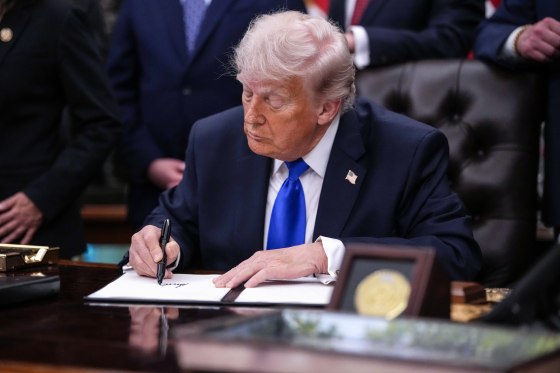
WASHINGTON — President Donald Trump signed an executive order on Thursday calling for a new government website where people in the United States can find and compare private-sector retirement savings accounts, aiming to help millions of workers whose employers do not offer such plans.

The order is intended to help more people gain access to retirement plans before next year, when the federal government will start matching retirement contributions made by lower-income workers.

That new matching contribution, known as the Saver’s Match, comes from 2022 legislation passed under Democratic President Joe Biden. Starting in January, it will offer a match of up to $1,000 for workers who make less than $35,000 a year.

Trump’s order is meant to help make the match available to roughly 50 million people who do not have retirement plans offered by their employers. The Republican president directed the Treasury Department to launch TrumpIRA.gov, where workers will be able to compare private-sector retirement plans.

“For millions of Americans who lack employer-sponsored plans, this will be really revolutionary, because they’ll be covered,” Trump said at an Oval Office signing ceremony.

He is not offering a new government retirement plan but helping match workers with existing plans from private companies.

Details of the order were first reported by the news outlet Semafor.

Trump discussed the idea during his State of the Union address in February, when he noted that about half the people in the country do not have access to employer-provided retirement plans with matching contributions.

“To remedy this gross disparity, I’m announcing that next year my administration will give these often-forgotten American workers — great people, the people that built our country — access to the same type of retirement plan offered to every federal worker,” Trump said.

The Saver’s Match program will offer a maximum match of $1,000 for single filers and $2,000 for married couples who file jointly. The maximum will be limited to single filers earning less than $20,500, with smaller matches offered for those earning up to $35,500. It applies to contributions made toward 401(k) plans, IRAs and Roth IRAs.

Trump said he wants to take the match “to the next level” by asking Congress to expand it to those with incomes higher than $35,000 a year. Kevin Hassett, director of the White House’s National Economic Council, said many middle-income earners also lack access to employer retirement plans.

“We’re working with Congress to significantly expand this program and are looking forward to legislation this year,” Hassett said at the ceremony.

Americans are getting smaller pay raises while tariffs and higher gas prices are threatening to make everything more expensive.

Translation: The affordability problem isn’t improving.

New government data released Friday showed non-supervisory workers getting a 3.4% pay raise on average hourly earnings over the last year. That’s the slowest pace of wage gains since 2021, and a downshift from the last two years, when pay bumps were closer to 4%.

The slowdown comes as economists worry about rising inflation, with the Iran war choking off oil tankers and pushing gas prices up over $1 per gallon in just a month, to a national average of $4.09 on Friday.

As diesel costs break $5.50 a gallon (compared to just $3.89 a month ago), retailers and grocers are now contending with higher transportation costs. Amazon said Thursday it will begin charging sellers a 3.5% “fuel and logistics-related surcharge” beginning on April 17.

Airlines like United and JetBlue are raising bag fees in an effort to offset sky-high jet fuel costs. The International Air Transport Association says the price of jet fuel is up 104% in the past month.

“With the recent uptick in inflation driven by energy prices, real wage growth is likely to decelerate further, putting increased pressure on consumers,” said Thrivent’s chief financial and investment officer, David Royal.

For now, Americans are still seeing their earnings rise at a faster pace than the increase in price tags at the store. As pay rose by 3.4%, the most recent inflation data showed prices rising by 2.4% year-over-year.

Wage gains for non-supervisory employees — a category that includes roughly four out of every five non-farm workers — have been outpacing price increases since March 2023, when post-pandemic inflation finally began to cool.

But the concern is that the story could change soon. Because of the bump from oil prices, Navy Federal Credit Union Chief Economist Heather Long said it’s possible inflation could pace at 4% this month.

“Four percent is above that 3.5 percent annual wage gain, and that’s where you see a lot of squeeze on workers, particularly middle-class and moderate-income workers,” Long said.

Warning signs are flashing that slowing wage growth could ripple beyond the gas station and prices at the grocery store. Higher mortgage rates now have some worried about icing out even more potential homebuyers.

The average 30-year fixed mortgage rate rose from 5.99% at the start of the war to 6.45% on April 3, according to Mortgage News Daily. The rise is due in part to concerns that the Federal Reserve will have to raise interest rates to tamp down on war-driven inflation.

“With choppy job growth, weaker labor-force attachment and rising uncertainty, many households — especially renters and first-time buyers — could become more cautious as weaker inflation-adjusted wages erode recent affordability improvements,” said Zillow senior economist Orphe Divounguy.

If wages can’t keep up with rising costs across the board, it’s likely that affordability will become a larger issue than it already was prior to the war. An NBC News poll conducted during the first week of the war with Iran found that, for a plurality of respondents, inflation and the cost of living was the most important issue facing the country.

Economists feel the same way.

Responding to a question from NBC News at a March 18 news conference, Federal Reserve Chair Jerome Powell noted that “real” wage gains — a measure of wages adjusted for inflation — need to be positive in order for Americans to feel better about affordability.

“it will take some years of positive real earning gains for people to feel good again, we think. But you’re right — when you talk to people, they do feel squeezed,” Powell said.

Oil prices surged Thursday, threatening to further drive up the price of gas as hopes for a near-term resolution to the Iran war faded following President Donald Trump’s address to the nation.

Stocks were volatile, with major indexes plunging early in the day before moving higher at the close on shifting headlines about the war in the Middle East.

U.S. indexes recovered their early losses on news that Iran’s deputy foreign minister said his country would outline a “new navigation regime” in the Strait of Hormuz after the war ended, injecting fresh optimism into markets over the future of the key waterway.

At the closing bell at 4 p.m. ET, the S&P 500 closed up 0.11%, the Nasdaq Composite ended higher by 0.18%, and the Dow Jones Industrial Average fell 61 points. The Russell 2000 index, which tracks smaller companies, rose 0.7%.